Philadelphia’s urban fabric stretches across two distinct physiographic provinces—the Atlantic Coastal Plain and the Piedmont—a geological boundary that has shaped development from William Penn’s grid to modern high-rise construction in Center City. The Coastal Plain, with its unconsolidated sands and clays, behaves entirely differently than the weathered schist and gneiss of the Wissahickon Formation underlying Northwest Philadelphia. This transition zone creates variable bearing conditions that demand site-specific subsurface data before any foundation decision. Our team has performed hundreds of SPT (Standard Penetration Test) borings across the city, from deep excavations near the Delaware River to residential additions in Chestnut Hill. Understanding the local stratigraphy—and how the water table fluctuates seasonally by several feet—is not optional here; it is the baseline for safe design. When preliminary investigations indicate complex layering, we often pair SPT with a CPT test to refine the soil profile in soft organics or loose hydraulic fills.
In Philadelphia’s Coastal Plain, an SPT N-value below 4 at depths above the water table is often the first indicator of liquefiable sand—something we never ignore.
Scope of work in Philadelphia
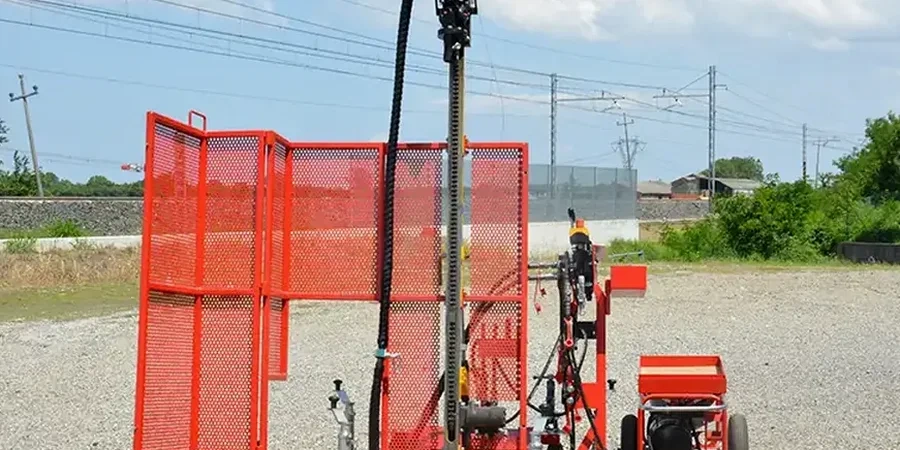
Local geotechnical conditions in Philadelphia
Compare two sites: one in Northern Liberties on historic fill and alluvial deposits, another in Wynnefield on competent Wissahickon schist residuum. At the Northern Liberties site, SPT N-values of 2 to 5 in the upper 15 feet demand deep foundations or rigorous ground improvement—driving piles through demolition debris and loose silt without borings is a costly gamble. At the Wynnefield site, refusal at 8 feet on weathered rock might mislead a designer into assuming shallow footings are adequate, until a core reveals steeply dipping foliation planes that create a sliding risk. The SPT alone does not solve these problems; it frames the right questions. In areas like Eastwick, built on hydraulically placed dredge spoils, the test becomes a screening tool for liquefaction potential under the design earthquake, a scenario the Philadelphia Water Department and PennDOT require for critical infrastructure.
Our services
Our SPT program in Philadelphia integrates seamlessly with laboratory characterization and advanced in-situ testing to deliver a complete geotechnical package for your project.
SPT with Lab Index Testing
Each split-spoon sample undergoes visual classification, with selected specimens tested for moisture content, grain size distribution, and Atterberg limits at our ISO 17025 accredited lab. We deliver N60-corrected borehole logs and a stratigraphic summary within 5 business days.
Seismic Site Class Determination
Using SPT N-values and shear wave velocity correlations, we establish the Site Class (A through F) per ASCE 7 and IBC. This is critical in Philadelphia where the transition from Site Class D to E can double seismic design forces.
Liquefaction Triggering Analysis
For saturated sands in the Coastal Plain, we evaluate cyclic stress ratio versus cyclic resistance ratio using Seed-Idriss and Boulanger-Idriss procedures, providing a factor of safety against liquefaction at each SPT depth.
Q&A
What does an SPT in Philadelphia typically cost?
A standard SPT boring program in Philadelphia, including mobilization, drilling, sampling at 5-foot intervals, and a summary report with N60 corrections, typically runs between US$630 and US$740 per borehole for depths up to 50 feet. Deeper borings, confined access rigs near row homes, or rush turnaround can shift the final figure.
How many SPT boreholes does the Philadelphia Building Code require?
The Philadelphia Building Code (IBC-based) requires a minimum of one boring per 2,500 square feet of building footprint for structures under 160 feet in height, with a minimum of three borings total. Our team determines the final count based on site variability—Coastal Plain sites often need tighter spacing than Piedmont rock sites.
Can you drill SPT borings in a Center City basement with limited access?
Yes. We deploy compact track-mounted rigs that fit through standard 36-inch door openings and operate with less than 10 feet of headroom. These rigs use an automatic hammer system and can reach depths of 60 feet in tight urban basements without compromising ASTM D1586 compliance.
How do you handle SPT refusals on Wissahickon schist?
When SPT blow counts exceed 50 per 6 inches, we switch to rock coring with an NQ or HQ core barrel. The refusal depth is noted on the boring log, and we typically advance 5 to 10 feet into competent rock to confirm it is not a floating boulder—a common occurrence in the Piedmont’s weathered profile.