The soil profile in Philadelphia shifts dramatically depending on where you dig. Over in Society Hill and Old City, you'll often hit deep layers of artificial fill mixed with historic demolition debris, making particle size distribution wildly inconsistent. Cross the Schuylkill into University City, and the geology transitions into the decomposed mica schist of the Wissahickon Formation, producing silty fine sands that behave completely differently under load. This contrast isn't just academic trivia—it directly impacts foundation design, drainage planning, and slope stability. Knowing the exact gradation of your site’s soil is where our grain size analysis (sieve + hydrometer) comes in. We run the full mechanical sieve stack down to the No. 200 sieve, then transition to the hydrometer for the fines fraction, giving you a complete particle-size curve. For sites near the Delaware River with soft organic silts, this data is critical for estimating settlement rates, and we often pair it with a CPT test to validate in-situ behavior without disturbing the sample fabric.
A complete hydrometer analysis in Philadelphia’s coastal plain sediments often reveals a hidden 15-20% clay fraction that standard sieve tests miss entirely.
Scope of work in Philadelphia
Local geotechnical conditions in Philadelphia
With a population exceeding 1.6 million in the city proper and extensive infrastructure dating back to the 19th century, Philadelphia’s underground is a patchwork of old foundations, buried stream beds, and undocumented fills. Skipping a detailed grain size analysis here is a gamble. The wrong soil classification can lead to specifying an undersized drainage aggregate that clogs instantly, or misidentifying a silty sand as a clean sand, resulting in an overestimation of bearing capacity. We’ve seen projects near the Cobbs Creek area where a hydrometer analysis revealed a sensitive clay fraction that standard borings completely missed, a scenario that would have led to severe differential settlement in the planned mat foundation. Understanding the gradation isn’t just about checking a box for the permit office; it’s about protecting the structure from the aggressive freeze-thaw action that plagues the I-95 corridor.
Our services
We provide a comprehensive suite of lab-based and field-ready soil classification services tailored to the unique geology of the Philadelphia region, from the Coastal Plain sediments to the Piedmont metamorphic rocks.
Complete Mechanical Sieve Analysis
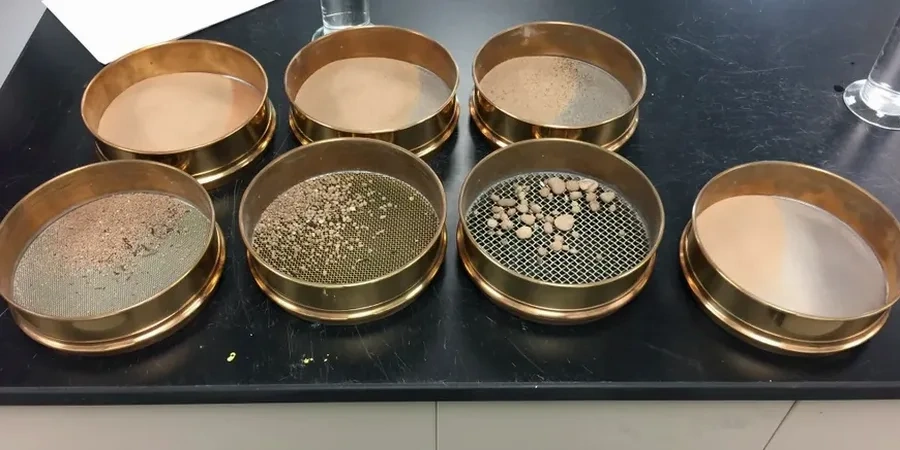
We process bulk samples through a full nest of ASTM-compliant sieves, determining the mass retained on each. This service covers coarse gravels down to fine sands, providing the essential data for filter design, concrete aggregate suitability, and drainage media specification.
Hydrometer Sedimentation Analysis
For the silt and clay fraction passing the No. 200 sieve, we apply the ASTM D7928 hydrometer method. Using a dispersing agent and controlled sedimentation cylinder, we track the density of the soil-water suspension over time to accurately map particle sizes down to 1 micron.
Q&A
What is the typical cost for a grain size analysis in Philadelphia?
The cost for a full grain size analysis including both mechanical sieving and hydrometer testing generally falls in the range of US$110 to US$190 per sample. The exact price can vary slightly depending on the percentage of coarse material and whether the sample requires special preparation, such as washing over the No. 200 sieve to remove excessive fines before the main test.
How much soil sample do I need to send for a gradation test?
It depends on the maximum particle size visible in the soil. For fine-grained soils and sands, about 500 grams is typically sufficient. If the material contains gravel or cobbles, we need a larger representative sample, ideally 5 kilograms or more, to ensure the sieving process accurately reflects the field gradation per ASTM D6913 guidelines.
How long does the hydrometer analysis take compared to the sieve test?
The mechanical sieve test is relatively quick, usually completed within a day. The hydrometer analysis takes longer because it relies on sedimentation physics; we take readings at specific intervals over a minimum of 24 hours, sometimes up to 48 hours, to accurately capture the settlement of the finest clay particles in the suspension.
Can you classify the soil type just from a grain size test?
Yes, we classify the soil according to the Unified Soil Classification System (USCS) using the gradation curve from the sieve and hydrometer results. However, for a complete classification that includes the symbol for silts and clays (like CL or MH), we highly recommend running Atterberg limits tests on the fines fraction to determine the liquid and plastic limits.
Do you test soils containing organic material from sites near the Schuylkill River?
Yes, we can process soils with organic content, but it’s important to notify us beforehand. Standard practice involves oven-drying the sample at 110°C, which can alter the properties of highly organic soils. For organic clays or peats, we adjust the drying temperature or test the material at its natural moisture content to avoid misrepresenting the particle size distribution.