Across Philadelphia, from the variable fills of the Delaware riverfront to the residual schist and gneiss of the northwest, achieving spec density in structural backfill is rarely straightforward. We see contractors battle urban fill with brick fragments and cinder layers where a single nuclear gauge reading can be misleading. The sand cone method per ASTM D1556 gives you a direct, physical measurement of in-place density—no calibration shifts from inconsistent moisture or heterogeneous debris. It is the referee test when compaction disputes arise on a PennDOT roadway subbase or behind a retaining wall in Manayunk. Our crew runs the test in foundation excavations, utility trenches, and pavement subgrades across all five counties, comparing dry unit weight against the laboratory Proctor curve to deliver a compaction percentage you can take to the City inspector without hesitation.
A sand cone test gives you a physical volume measurement that no nuclear gauge can falsify—essential when Philadelphia's urban fill confuses indirect methods.
Scope of work in Philadelphia
- Independent of radioactive source licensing or operator radiation training
- Effective in coarse granular fills where the CBR road test also requires density correlation
- Requires flat, prepared surface—sloped sites need a leveling plate and careful technique
- Typical test depth ranges 4–6 inches, capturing one lift, with deeper tests possible using larger-diameter plates
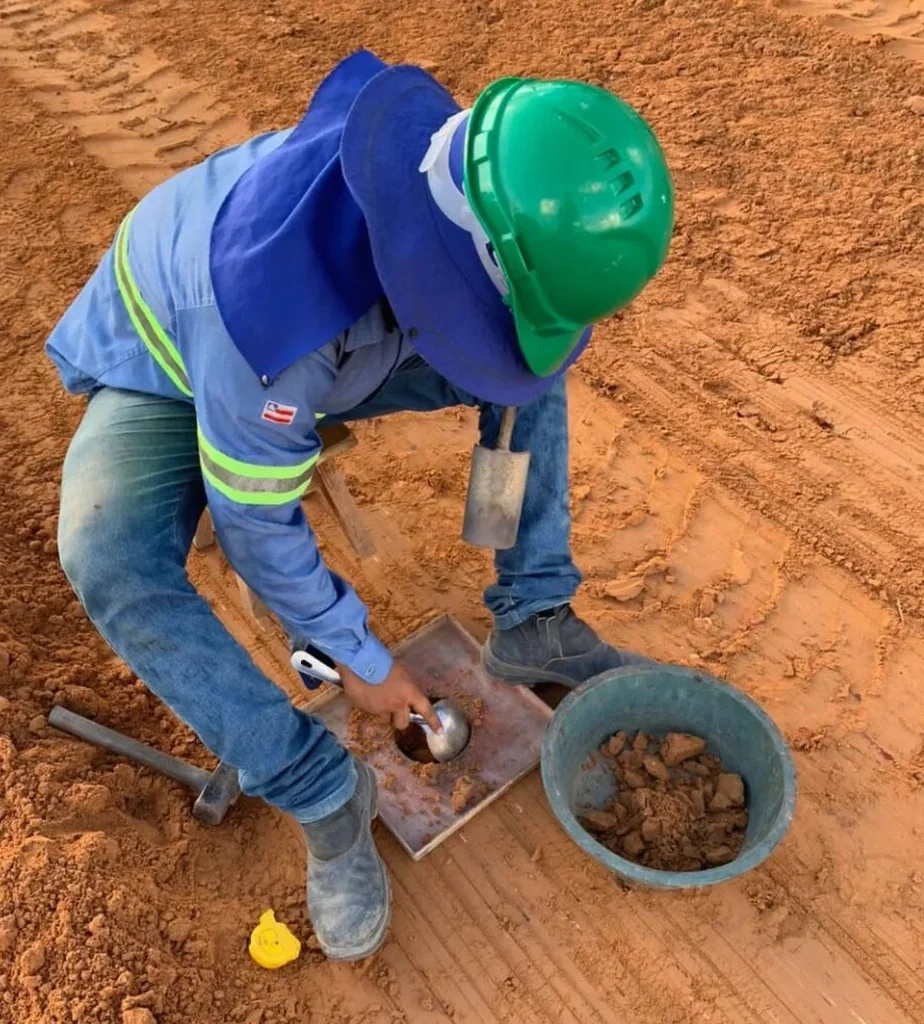
Local geotechnical conditions in Philadelphia
A mid-rise mixed-use project off Broad Street in North Philadelphia had placed six lifts of structural fill over a former industrial parcel. The earthwork sub relied on nuclear density testing, and the numbers looked fine—until a City inspector requested correlation tests. Our sand cone results on three separate lifts came back 8–12 percent below the nuclear readings. The culprit was heterogeneous fill containing slag and crushed brick; the nuclear gauge had been calibrated on a uniform sandy soil and overestimated density. The contractor had to re-compact and re-test 2,500 square yards, adding five days to the schedule. In Philadelphia's urban geology, skipping direct volumetric verification is a schedule risk that compounds fast. We also see this in utility trench backfill where footings for adjacent structures will later impose load, and poorly compacted soil leads to settlement claims that no one wants to litigate.
Our services
Our Philadelphia field density program covers the full compaction verification cycle, from laboratory Proctor reference curves to in-place sand cone testing and final compliance reports stamped by a licensed professional engineer.
Compaction Curve Development
Standard and Modified Proctor testing (ASTM D698 and D1557) on your project's specific borrow source or imported fill, establishing the target maximum dry density and optimum moisture content before field compaction begins.
In-Place Density Verification
Sand cone testing per ASTM D1556 at the frequency required by your ITP, with same-day or next-day reports showing wet density, dry density, moisture content, and percent compaction for each lift tested.
Q&A
What does a sand cone density test cost in Philadelphia?
A single ASTM D1556 sand cone test including field work, moisture content determination, laboratory Proctor correlation, and a stamped report typically runs between US$110 and US$140 per test location. Volume discounts apply on projects requiring more than 15 tests per mobilization.
How does the sand cone method compare to nuclear density testing?
The sand cone per ASTM D1556 is a direct measurement: you excavate soil, measure its mass and the volume of the hole using calibrated sand, and calculate density from first principles. Nuclear gauges infer density from gamma radiation backscatter or transmission and require site-specific calibration. In Philadelphia's heterogeneous urban fills with variable moisture and debris, sand cone is the definitive referee method and is often required by City inspectors when nuclear readings are in dispute.
How many sand cone tests does PennDOT require per lift?
PennDOT Publication 408 specifies minimum testing frequencies based on area and material type. For roadway subbase, a typical requirement is one field density test per 1,500 to 3,000 square feet per lift, with additional tests at random locations selected by the inspector. Structural fill under foundations inside the building footprint often follows a tighter grid specified in the project's inspection and testing plan.
Can the sand cone test be used in granular soils with coarse particles?
Yes, the method works in soils containing particles up to about 1.5 inches in diameter when using the standard 6.5-inch plate. For soils with larger particles or cobbles, ASTM D1556 allows a larger 12-inch-diameter plate and correspondingly larger sand volume, which improves representativeness. In very coarse material, we also recommend a test pit excavation to visually characterize particle size distribution.
How soon after compaction can the sand cone test be run?
The test can be performed immediately after compaction and grading are complete, provided the surface is prepared flat and the lift thickness does not exceed 8 inches for standard plates. There is no waiting period. Results including moisture content and percent compaction are available the same day or by the following morning.