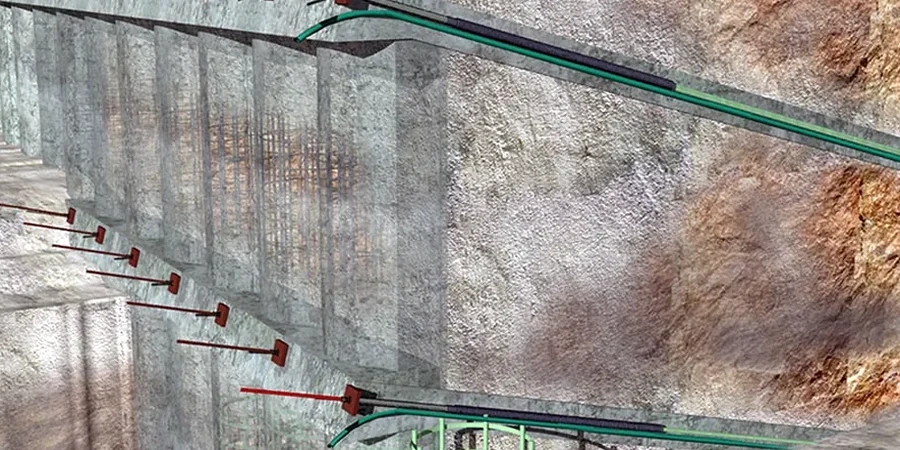
Philadelphia’s dense urban fabric and layered geology demand restraint systems that work with the ground rather than against it. The city expanded over centuries atop metamorphic bedrock, decomposed schist, and wide bands of estuarine clay and fill along the Delaware and Schuylkill rivers. When a deep excavation approaches a historic masonry party wall in Old City or a sensitive Amtrak viaduct in University City, passive soil nails often reach their practical limit. That’s where high‑capacity active tieback anchors step in. Our design approach integrates site‑specific in-situ permeability data because anchor bond zones in Philadelphia’s micaceous silt require precise grout‑to‑ground stress transfer, and we calibrate stiffness parameters with CPT testing to avoid creep in the Wissahickon formation.
Proof‑testing to 133% of design load, with creep held under 1 mm over the log‑time cycle, confirms the anchor will perform long‑term in Philadelphia’s variable residual soils.
Scope of work in Philadelphia
Local geotechnical conditions in Philadelphia
The risk profile changes dramatically between the dense glacial outwash of North Philadelphia and the compressible organic silts along the Delaware River in South Philadelphia. In the northern sections, high bond stresses are achievable but the ground can mask fresh‑rock pinnacles that deflect drilling and create ungrouted gaps. Down near the Navy Yard, the water table sits barely six feet below grade, and a passive anchor embedded in soft organic clay will simply pull out unless the design accounts for staged excavation and drainage before stressing. A misjudged unbonded length in either setting converts a working anchor into a liability: early lock‑off loss in clay or brittle fracture at the anchor head in rock. We specify sacrificial load cells on critical anchors in Philadelphia so the engineer can track relaxation across seasons.
Our services
Anchor design in Philadelphia spans multiple phases, from feasibility to long‑term monitoring. We provide a complete engineering package that aligns with the local permitting process and the Philadelphia Building Code.
Feasibility‑Level Anchor Design
We review existing borings and run limit‑equilibrium analyses to determine whether active tiebacks are viable given adjacent foundation geometry and right‑of‑way constraints.
Tendon & Corrosion Protection Design
Permanent anchors in Philadelphia require Class I protection; we specify encapsulating corrugated sheathing and factory‑grouted strand for 75‑year service life.
Load‑Test Program Management
We write the performance‑test specification, witness the field work, and interpret load‑extension curves to validate the bond‑zone friction assumptions.
Long‑Term Monitoring Setup
For critical shoring adjacent to SEPTA tunnels or historic structures, we design a monitoring plan with vibrating‑wire load cells and optical survey targets.
Q&A
What is the cost range for an active anchor design and testing package in Philadelphia?
A complete design package with three sacrificial extended‑creep tests and proof‑testing for a typical 30‑anchor shoring wall runs between US$1,000 and US$3,250 per anchor, covering engineering, load‑test supervision, and final stamping. The spread depends on access logistics and whether the bond zone is in soil or rock.
How does Philadelphia geology affect anchor bond‑zone selection?
The Piedmont province west of the Fall Line gives us weathered Wissahickon schist that holds high bond stress but can decompress quickly if the hole is left open. East of the Fall Line, the Coastal Plain sediments require pressure‑grouted bond zones in granular strata. We always run a pre‑production pull‑out test before finalizing the bond length.
When is a passive anchor sufficient versus an active tieback system?
A passive anchor works where the ground can tolerate a few inches of movement before the anchor engages. In Philadelphia, that often rules out passive systems next to brittle masonry buildings or active rail corridors. If the allowable lateral deflection is under half an inch, an active tieback prestressed to 80% of design load is the safer path.