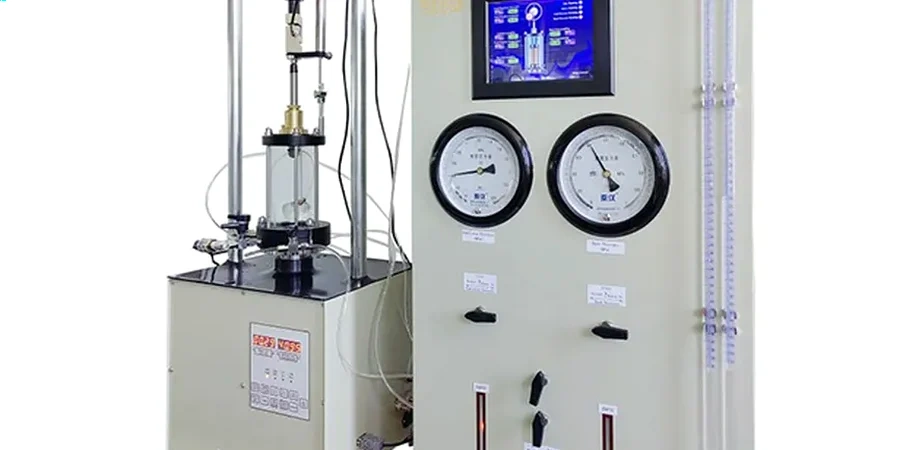
When you're designing a deep foundation near the Delaware River or assessing an excavation in Old City, assumptions about soil strength can get expensive fast. In Philadelphia, we routinely encounter decomposed Wissahickon schist mixed with urban fill, and the transition zones between these materials demand more than a pocket penetrometer. The triaxial test gives us the drained and undrained strength parameters that actually reflect in-situ behavior. We've run these tests for years out of our accredited lab, and what stands out in this city is how much the local geology punishes generic soil models. For projects where settlement or lateral deformation is a concern, we often pair triaxial data with a CPT test to calibrate the continuous profile, or with slope stability analysis when the site sits near the Manayunk or Wissahickon valley walls.
In Philadelphia's urban fill and residual schist, a proper triaxial test can reveal a friction angle difference of 4 to 6 degrees compared to simpler methods, which changes foundation dimensions and cost.
Scope of work in Philadelphia
Local geotechnical conditions in Philadelphia
Philadelphia's adoption of the 2018 IBC with Chapter 18 supplements means geotechnical reports here face real scrutiny, especially in areas mapped as having artificial fill over 10 feet thick. The most common failure we see in local projects isn't catastrophic collapse, it's excessive differential settlement driven by mischaracterized silty clays. A standard unconfined compression test on these materials often overestimates strength because it can't account for pore pressure buildup under the sustained loading of a five-story mixed-use building. Running a consolidated-undrained triaxial test with pore pressure measurement gives you effective stress parameters that completely change the bearing capacity equation. In our experience, the cost of skipping this step shows up later in change orders or, worse, in litigation when adjacent historic structures start showing cracks. For sites near the Schuylkill, we also recommend evaluating liquefaction potential given the loose alluvial sands that dominate the floodplain deposits.
Our services
Our Philadelphia triaxial testing program is built around the specific challenges of local geology and construction practice. We don't just run the test and hand you a friction angle; we interpret the results in the context of your project's foundation type and the site's stress history.
Multi-stage triaxial testing for deep foundations
When we're working with limited sample recovery from a deep boring, multi-stage testing on a single specimen provides a complete Mohr-Coulomb envelope without needing three identical samples. This is particularly useful in Philadelphia's variable residual soils where obtaining multiple intact specimens at the same depth is rarely possible.
Stress path testing for excavation support design
For projects involving deep excavations near existing buildings, such as basement construction in Center City, we run stress path triaxial tests that follow the actual loading-unloading sequence the soil will experience. The stiffness parameters from these tests feed directly into finite element models for wall deflection prediction.
Q&A
What's the cost of a triaxial test program in Philadelphia?
For a typical project requiring three CU triaxial tests with pore pressure measurement, the cost ranges from US$1,940 to US$2,760 depending on sample preparation difficulty and the required confining stress range. Multi-stage tests or CD tests fall toward the upper end.
How long does it take to get triaxial test results?
A standard CU triaxial test with three specimens takes 5 to 7 business days after sample preparation. Consolidated-drained tests run longer, typically 10 to 14 days, because of the slow shear rate required to maintain drained conditions. We can expedite to 3 days for UU tests when the site schedule demands it.
Can you run triaxial tests on Philadelphia's Wissahickon schist residual soil?
Yes, this is one of the most common materials we test. The residual soil from the Wissahickon Formation requires careful specimen trimming because of its mica-rich structure and occasional quartz veining. We use a wire saw and freezing technique for particularly fragile samples to preserve natural structure.
Which triaxial test type do I need for a retaining wall design?
For retaining wall design in Philadelphia, we typically recommend consolidated-undrained tests with pore pressure measurement. This gives you both total stress parameters for short-term construction conditions and effective stress parameters for long-term drained conditions. If the wall is near the river, we also account for fluctuating groundwater and run tests at saturation levels matching the highest expected phreatic surface.