One of the most persistent mistakes we see on Philadelphia job sites is assuming that a cut slope in weathered Wissahickon Schist will stand up through a full winter cycle without proper benching. The mica-rich foliation planes in this bedrock act like miniature slip surfaces once water infiltrates and freezes, a condition that surprises contractors who are more accustomed to the Coastal Plain sediments across the river in New Jersey. The Philadelphia City Planning Commission and L&I reviewers now routinely flag projects that lack a slope stability analysis backed by site-specific shear strength data, particularly for excavations deeper than 12 feet in the Manayunk and Roxborough corridors. Since the updated IBC 2021 adoption and the city's stormwater management requirements have increased infiltration loads on retained slopes, we integrate laboratory triaxial testing and field reconnaissance to establish the true factor of safety for both short-term and long-term conditions. The local geology—with its saprolitic horizons and occasional graphitic seams—means that generalized textbook parameters simply do not hold. When we encounter fills overlying the old mill race remnants in neighborhoods like East Falls, we often pair the stability analysis with an in-situ permeability test to quantify how quickly perched groundwater migrates through the anthropogenic layer.
A factor of safety of 1.0 on Wissahickon Schist is not a number—it is a liability. We target 1.5 for static and 1.1 for pseudo-static conditions per ASCE 7-22.
Scope of work in Philadelphia
Local geotechnical conditions in Philadelphia
Philadelphia sits at the boundary between the Piedmont and Atlantic Coastal Plain physiographic provinces, and the Wissahickon Formation bedrock is notorious for deep weathering profiles that can extend 30 meters below the surface in some areas. Coupled with a design earthquake spectral acceleration of about 0.25g for Site Class C on the USGS hazard maps, a slope that appears perfectly stable under dry summer conditions can lose 40% of its factor of safety when the schist saprolite becomes saturated during a late-winter thaw. The biggest risk we see is not catastrophic failure during construction, but the slow, progressive creep that goes unnoticed for three or four years until foundation cracks appear in homes on the upper bench. Owners who skip the slope stability analysis and rely solely on a visual inspection from a geotechnical engineer often end up facing a remediation bill that is four to six times the cost of the original study. We have also observed that many older retaining walls in Germantown and Mt. Airy were built without weep holes or proper drainage blankets, which creates hydrostatic pressure behind the wall and destabilizes the entire slope mass above it. A rigorous analysis must account for these legacy drainage deficiencies and model the worst-case phreatic surface accordingly.
Our services
Our slope stability analysis in Philadelphia encompasses the full cycle from field investigation through remediation design, tailored to the specific geologic constraints of the Wissahickon Schist, Trenton Gravel, and urban fill environments. Each service described below is performed under the direction of a licensed Professional Engineer in Pennsylvania.
Limit Equilibrium Stability Modeling
We build detailed cross-sections in Slide2 or SLOPE/W using laboratory-measured shear strength parameters from our triaxial and direct shear tests. Each model includes multiple piezometric surfaces, seismic loading per ASCE 7-22 Section 11.8, and sensitivity analyses on the cohesion and friction angle of the critical mica-rich layers.
Reinforced Slope and Retaining Structure Design
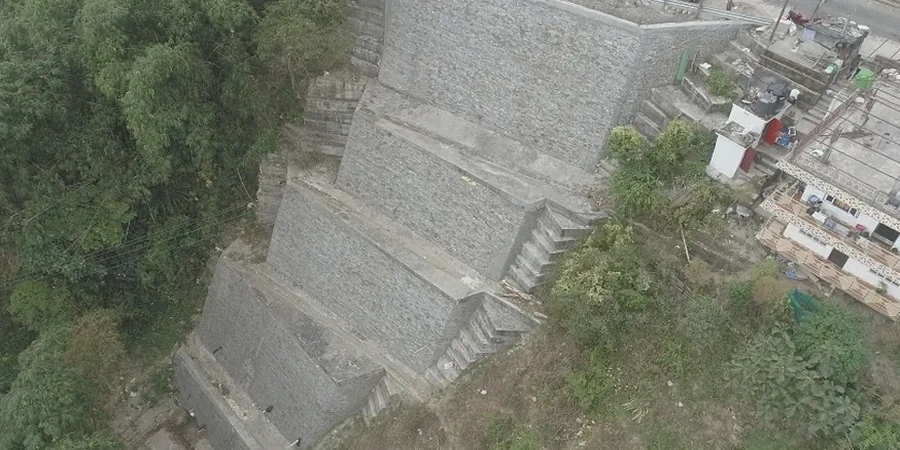
When the calculated factor of safety falls below the IBC 2021 minimum, we design soil nail arrays, mechanically stabilized earth (MSE) walls, or anchored soldier pile systems to restore stability. Our designs account for the aggressive weathering rates of the local schist and specify shotcrete facing with encapsulated reinforcement to prevent corrosion.
Construction-Phase Instrumentation and Monitoring
For slopes adjacent to occupied structures in dense neighborhoods like Society Hill, we install inclinometers and piezometers to track lateral movement and pore pressure in real time during excavation. Trigger levels are established in advance so that the contractor can adjust the cut sequence before any distress becomes visible at the surface.
Q&A
What is the typical cost range for a slope stability analysis on a residential lot in Philadelphia?
For a single-family lot on a moderate slope (less than 20 degrees) with accessible borings, the analysis and signed report typically range from US$1,400 to US$3,630 depending on whether laboratory shear strength testing is required and the number of cross-sections that must be modeled. Projects that involve complex groundwater conditions or require a seismic deformation analysis will fall toward the upper end of this range.
How does the Wissahickon Schist affect slope stability compared to other rock types?
The Wissahickon Schist is a foliated metamorphic rock rich in mica and quartz, and its foliation planes create inherent planes of weakness that can fail translationally when oriented downslope. Weathering produces a thick saprolite zone that retains the original schist structure but has lost much of its cementation, so shear strengths can drop from intact values above 30 MPa to residual values below 0.1 MPa in the weathered zone. This requires careful distinction between rock and soil behavior in the stability model.
What triggers a mandatory slope stability review by the Philadelphia L&I department?
Under the Philadelphia Building Code (IBC 2021 Chapter 18), a slope stability analysis is typically required when a proposed cut or fill exceeds 5 feet in height on slopes steeper than 3 horizontal to 1 vertical (approximately 18 degrees), or when the proposed construction is located within a mapped landslide hazard area. The reviewer will also request it if the geotechnical report identifies a factor of safety below 1.5 for permanent static conditions.