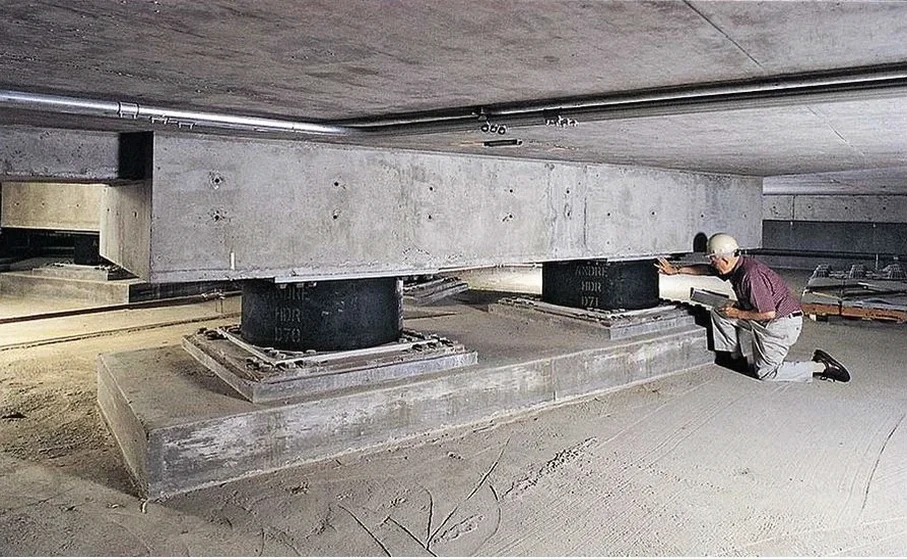
Philadelphia sits on a complex geological transition—the hard Wissahickon Schist of the Piedmont gives way to the unconsolidated Coastal Plain sediments south of the city. This abrupt change, combined with the city’s location roughly 50 miles from the Ramapo Fault zone, creates a seismic environment that standard fixed-base design does not always handle well. When we design a base isolation system for a Philly project, the first step is understanding which soil sits under the footprint: dense mica schist or compressible Trenton Gravel. The isolation bearings—typically high-damping rubber or friction pendulum—must be tuned to the site’s specific spectral acceleration. A CPT test through the Coastal Plain clays gives us the continuous soil profile needed to model ground motion amplification accurately, while seismic refraction helps map the depth to bedrock across the site, a critical parameter for selecting isolator stiffness.
A properly tuned isolation system in Philadelphia can reduce inter-story drift by 60-70% compared to fixed-base design, keeping hospitals and data centers operational after a design-basis event.
Scope of work in Philadelphia
Local geotechnical conditions in Philadelphia
Philadelphia County sits on a seismic hazard classified as moderate by the USGS, but the soil column can amplify long-period motion significantly. The unconsolidated sands and clays of the Coastal Plain, which underlie South Philly and the Navy Yard, have a fundamental period that often overlaps with the 1–2 second spectral range where mid-rise buildings concentrate energy. A base isolation design that ignores basin-edge effects—the reflection and trapping of seismic waves at the Piedmont-Coastal Plain boundary—can underestimate isolator displacement by 20% or more. We model this using site response analysis with deep shear wave profiles, often derived from MASW surveys that reach 100 feet or deeper. The 2011 Mineral, Virginia earthquake, felt strongly in Philadelphia high-rises, serves as a reminder that East Coast earthquakes propagate efficiently through the crust; an isolated building here must handle long-duration, low-amplitude shaking without degradation of the lead core or rubber compound.
Our services
Our base isolation work in Philadelphia covers the full design and verification cycle, from feasibility studies to construction-phase testing. Each service aligns with the IBC special inspection requirements and Chapter 17 of ASCE 7.
Nonlinear Time-History Analysis
Three-dimensional structural models with isolator elements calibrated to prototype test data. We run seven or more ground motion pairs scaled to the MCEr spectrum, per ASCE 7 requirements.
Isolator Specification and Procurement Support
Performance-based specifications covering effective stiffness, post-elastic behavior, aging limits, and factory production testing criteria.
Peer Review and Third-Party Checking
Independent verification of the isolation design, including upper- and lower-bound analyses, for Philadelphia Department of Licenses and Inspections submittals.
Construction-Phase Special Inspection
On-site verification of isolator installation, moat wall construction, and utility crossings to ensure the isolation plane remains functional.
Q&A
What does base isolation design cost for a Philadelphia building?
For a typical mid-rise structure in Philadelphia, the complete design package—including nonlinear analysis, isolator specifications, and peer review coordination—ranges from US$4,590 to US$9,470. The final figure depends on the number of isolators, the complexity of the superstructure, and whether site-specific ground motion studies are required by the IBC.
Does the Philadelphia building code require base isolation?
The Philadelphia code adopts the IBC with local amendments. Base isolation is not mandatory for all structures, but it becomes a strong option for Risk Category III and IV buildings (hospitals, fire stations, emergency operations centers) where continued functionality after an earthquake is required. ASCE 7-22 provides the design path once isolation is selected.
How do Philadelphia's soil conditions affect isolator performance?
The transition from Wissahickon Schist to Coastal Plain sediments creates site amplification that differs block by block. We run site response analysis using measured shear wave velocities, not default assumptions, to set the isolator effective period far from the soil’s natural period. This prevents resonance and keeps displacements within the moat clearance.
What testing is required for isolators on a Philadelphia project?
ASCE 7-22 Section 17.8 mandates prototype testing (full-scale bearings subjected to thermal aging, scragging, and cyclic loading) plus production testing on a sample from each batch. The special inspector must witness these tests and verify that the force-displacement loops match the design hysteresis model before installation proceeds.