Philadelphia sits on a complex transition zone where the crystalline Wissahickon Schist of the Piedmont meets the unconsolidated coastal plain sediments of South Philly. This geological boundary, running roughly along the Fall Line, means two adjacent lots can have completely different bearing strata — one on competent bedrock at 15 feet, the next on compressible clay extending past 60 feet. A rigorous soil mechanics study becomes the only reliable way to quantify that contrast before designing foundations. The city’s history of fill placement along the Delaware River adds another variable: undocumented ash, dredge spoils, and demolition debris often lie beneath what looks like level ground. Our laboratory processes undisturbed Shelby tube samples and performs consolidated-undrained triaxial tests under ASTM D4767 to deliver effective stress parameters that reflect actual in-situ conditions, not textbook assumptions.
Philadelphia’s Fall Line geology creates two foundation scenarios within a single city block — a soil mechanics study tells you which one you’re on.
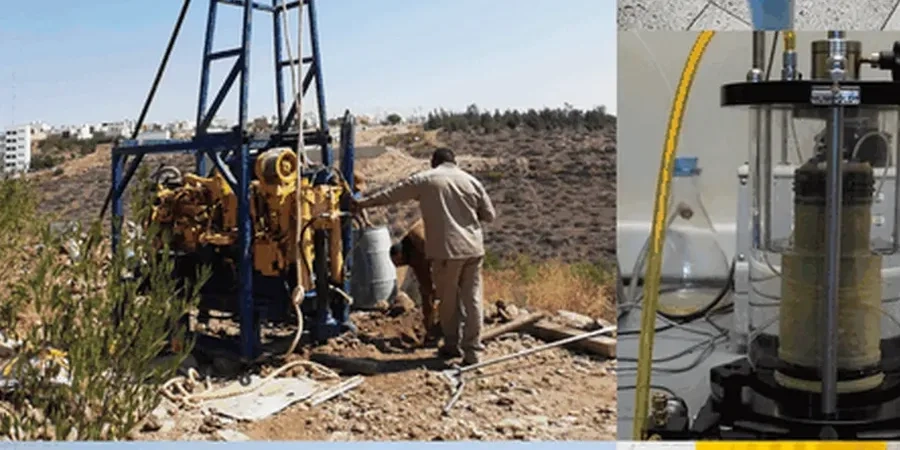
Scope of work in Philadelphia
Local geotechnical conditions in Philadelphia
Philadelphia is 94 feet above sea level at City Hall but drops to less than 10 feet across broad reaches of South and Southwest Philadelphia, where groundwater often sits within 5 feet of the surface. That shallow water table combined with 340 years of artificial fill placement creates a risk profile that standard exploration programs overlook. Loose saturated sands in the fill are susceptible to liquefaction under the design earthquake motions defined in ASCE 7-22 for Site Class D and E profiles. A soil mechanics study quantifies this hazard through cyclic stress ratio evaluation, comparing the seismic demand on each granular layer to its estimated cyclic resistance from SPT blow counts. Clay layers present a different problem: they consolidate slowly, and differential settlement between a heavier elevator core and lighter wing walls can crack finishes and bind doors. By running one-dimensional consolidation tests at multiple load increments, the lab determines exactly how much time-dependent deformation to expect — and whether preloading, wick drains, or deep foundations are worth the investment.
Our services
Every Philadelphia project encounters distinct subsurface conditions, and the soil mechanics study adapts to those conditions rather than applying a one-size protocol. The three service levels below cover most site investigation needs in the region.
Full geotechnical investigation
Deep borings with SPT sampling, laboratory testing of selected undisturbed specimens, groundwater monitoring, and a comprehensive report with foundation recommendations, excavation considerations, and seismic site classification.
Consolidation and settlement analysis
Targeted study for structures on compressible clays. Includes incremental load consolidation tests, time-rate curves, and settlement-versus-time predictions for mat foundations and embankment loads.
Liquefaction screening
Evaluation of loose saturated sands below the groundwater table using SPT-based cyclic stress ratio methods, with Factor of Safety calculations per Seed & Idriss simplified procedure and ASCE 7-22 criteria.
Q&A
What does a soil mechanics study cost for a typical Philadelphia rowhouse or small commercial lot?
For a single-lot investigation with two borings, basic lab testing, and a geotechnical report suitable for L&I permit submission, the range typically falls between US$3,310 and US$5,710. The final number depends on depth to bedrock, access constraints in dense neighborhoods, and whether undisturbed Shelby tube sampling is needed for settlement analysis.
How deep do borings need to go for a Philadelphia project?
Depth depends on foundation type and subsurface conditions. For shallow footings, borings typically extend to at least twice the footing width below the bearing elevation, or until competent stratum is confirmed. For deep foundations, borings go deeper than the anticipated pile tip elevation, often 60 to 80 feet or more in the coastal plain sediments of South Philadelphia.
Which Philadelphia neighborhoods have the most challenging soil conditions?
The Delaware River waterfront corridors — including parts of Fishtown, Northern Liberties, and Pennsport — contain thick sequences of historic fill, organic marsh deposits, and loose alluvial sands. The former tidal marsh areas of South Philadelphia also present compressible clays and shallow groundwater. The Wissahickon Valley and Chestnut Hill have shallower bedrock but can encounter weathered rock transitions that complicate excavation.
How long does a soil mechanics study take from field work to final report?
Field drilling and sampling for a typical Philadelphia lot usually takes one to two days. Laboratory testing adds about two to three weeks, depending on whether consolidation or triaxial tests are required. The final geotechnical report is typically delivered three to four weeks after field completion.