Philadelphia's urban geology shifts block by block. One site sits on decomposed Wissahickon schist while the next lies over deep Delaware River alluvium. Contractors learn quickly that a standard pavement section won't work everywhere. The laboratory CBR test gives us a direct number for subgrade strength, which feeds directly into the AASHTO pavement design equation.
We've seen imported fill on a South Philly project test at CBR 3 while a site in Manayunk, just four miles away, hits CBR 15 in natural ground. That difference changes the entire structural section. For Philadelphia projects where the subgrade shows high moisture, we often pair the lab soak with an in-situ permeability measurement to understand drainage behavior before finalizing the pavement design.
A soaked CBR value tells you more about a Philadelphia subgrade than any classification chart alone.
Scope of work in Philadelphia
We compact specimens at optimum moisture from a standard Proctor and submerge them in water while measuring swell. The plunger test then records resistance at 0.1-inch and 0.2-inch penetration. For projects on the Coastal Plain sediments south of the city, we will often supplement CBR data with a grain-size analysis to confirm fines content, especially when silt percentages approach 35 percent—a threshold where drainage and frost susceptibility demand attention. In fill areas near the old industrial waterfront, plate load test results can validate lab predictions against field modulus.
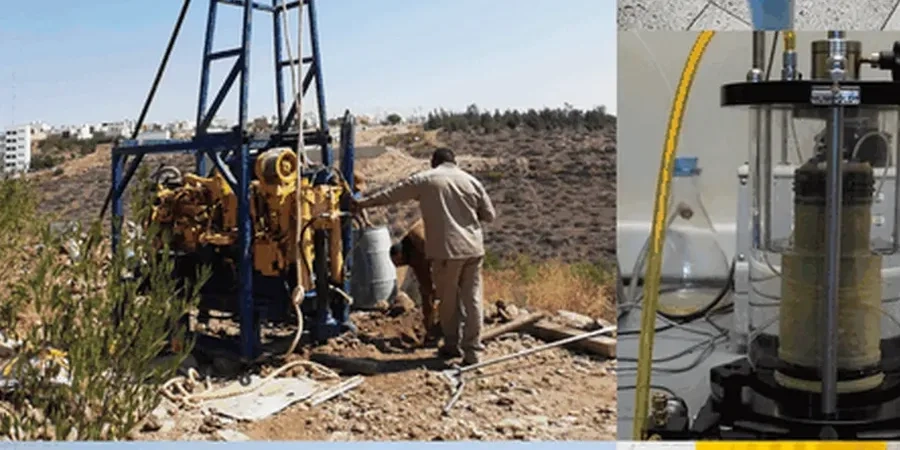
Local geotechnical conditions in Philadelphia
Philadelphia's 19th-century expansion buried streams and filled valleys across the city grid—Mill Creek, Dock Creek, and portions of Cohocksink Creek now run through sewers under streets and buildings. These unmapped fills, often mixed with ash, brick, and dredge spoil, create subgrades that look firm during a dry August but lose all bearing capacity after a wet March.
A laboratory CBR test on a bulk sample from these fills typically returns values below 4, and the soak swell can exceed two percent. Without this data, a pavement designed for CBR 10 on paper fails within two winters. The International Building Code ties foundation and pavement performance to site investigation, and the Philadelphia Department of Streets requires geotechnical documentation for right-of-way permits. Skipping the soak phase of the CBR test is the most common mistake we observe on small commercial projects.
Our services
Our Philadelphia materials laboratory runs CBR testing alongside a full suite of soils characterization services. Each test program is configured to match the specific subgrade conditions encountered on site.
Soaked Laboratory CBR
Four-day submerged test per ASTM D1883 with swell tracking and corrected bearing values at two penetration depths.
Modified Proctor Compaction
Determines maximum dry density and optimum moisture for specimen preparation prior to CBR testing, per ASTM D1557.
Resilient Modulus Estimation
Derives an estimated Mr value from the CBR result using AASHTO correlations for use in mechanistic-empirical pavement design.
Subgrade Classification Package
Combines CBR with Atterberg limits and grain-size distribution to classify soil per USCS and AASHTO systems for Philadelphia permit submissions.
Q&A
How much does a laboratory CBR test cost in Philadelphia?
A standard soaked CBR test typically runs between US$150 and US$190 per point when part of a larger geotechnical investigation. The final cost depends on the number of specimens and whether a companion Proctor compaction test is required. We provide a fixed-price quote before any work begins.
Why does the CBR specimen need to soak for four days?
The 96-hour soak simulates the worst-case saturated condition the subgrade will experience over the pavement's life. Philadelphia's drainage patterns and high water table in areas like South Philly mean the subgrade will see prolonged wet periods. A test on dry soil gives an unrealistically high CBR and leads to under-designed pavement.
What CBR value do Philadelphia parking lots typically require?
For light-duty parking lots, Philadelphia pavement designers generally look for a soaked CBR of 5 or higher in the upper 12 inches of subgrade. Heavy truck traffic areas, such as loading docks and industrial yards near the port, demand CBR values above 10 or a thicker aggregate base section. The final number comes from the traffic loading and the AASHTO design procedure.
Can you test samples we already collected from the site?
Yes. We accept undisturbed tube samples or bulk bags delivered to our laboratory. The key requirement is that the material remains at its natural moisture content inside a sealed container. We document the chain of custody and sample condition upon arrival. If the sample has dried out, the Proctor and CBR results will not represent field conditions.
How do I know if I need a standard or modified Proctor for specimen preparation?
Standard Proctor (ASTM D698) matches the compaction effort of typical light construction equipment used on Philadelphia commercial sites. Modified Proctor (ASTM D1557) applies to heavy roller compaction on highway projects or where the specification explicitly calls for it. We default to standard Proctor unless your project documents state otherwise.